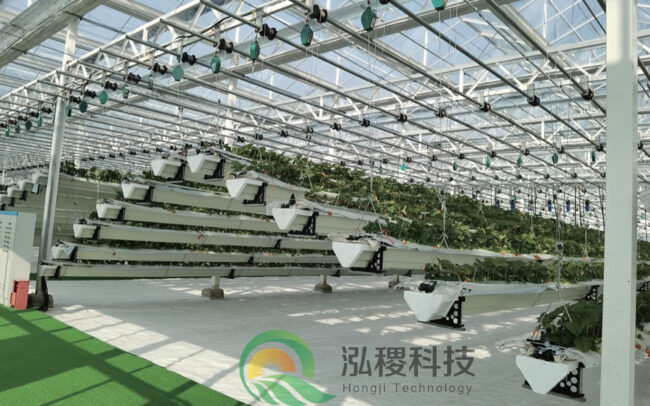
升降式V型栽培槽

The lifting strawberry cultivation trough system maximizes the use of the greenhouse’s vertical light and temperature environment, expanding the cultivation area. It eases production tasks like leaf – removal and harvesting, lessening labor intensity. It’s convenient for ground – based planting and enables free movement under the racks for pickers and tourists, boosting greenhouse space utilization and overall production benefits.
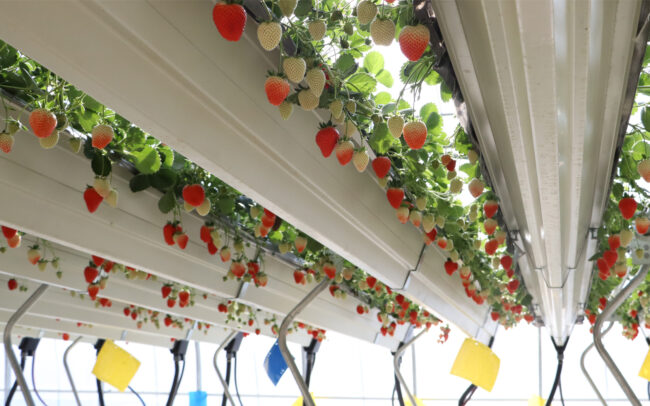
旋转式草莓栽培槽

The rotating strawberry trough planting system is a novel cultivation method. It efficiently utilizes space, forming passages when rotated and lying flat for sunlight absorption during growth. Its advantages include increased planting area and yield (doubling vs single-trough, +1/3 vs double-row), enhanced photosynthesis, reduced soil – borne diseases, convenient picking, favorable root growth in V – shaped troughs, and ease of sightseeing picking.

发酵核桃壳

Fermented walnut shells can serve as a filtering layer for the bottom of the pot in horticultural cultivation, and can also be used as a long-lasting organic fertilizer. After fermentation and maturation, walnut shells become organic materials because they are the outer shell of oil crops and contain various nutrients. Walnut shells, after fermentation and maturation, are a very high-quality organic material that contains various nutrients and is suitable for adding nutrient soil to various flowers. Especially when planting orchids, adding some rotten walnut shells to the planting material is

发酵松树皮

The pine bark of Xingsen Agricultural Technology Co., Ltd. in Gucheng County can improve soil permeability and water retention, providing sufficient nutrition for plants. Meanwhile, the organic acids produced during the fermentation process can regulate soil pH and inhibit the occurrence of pests and diseases. In summary, pine bark fermentation is a simple and effective horticultural method that can improve soil quality and provide plants with abundant nutrients. By collecting pine bark, preparing containers, adding humus or fertilizer, adding water, sealing fermentation, and conducting regula

非打磨普通松树皮

The natural characteristics of pine bark – high organic content; In suitable chemical composition, stable pH, low EC content, and high N P、K、Ca、Mg; Stable physical properties, uniform and slow decomposition, achieving long-term fertilization effect; Good breathability and the ability to control air and moisture. Pine bark has a wide range of applications in fields such as flower cultivation and crop cultivation. Pine trees with pine bark can grow in various soils. Due to the low ash content of coniferous trees, they can tolerate poor soil conditions, but have high productivity when planted in

打磨松树皮

The pine bark that has grown for many years is very thick, with a brown color and uniform size and thickness, with an average thickness of more than 2 centimeters. It looks like pebbles, has a smooth surface, clear patterns, and is beautiful and generous. The densest part of the material is the raw material, which is a high-quality covering made through processes such as crushing, grading, sun drying, and polishing. Polishing type coverings not only have all the advantages of ordinary coverings, but also have high ornamental value like handicrafts. Moreover, the material is thick and has a lon